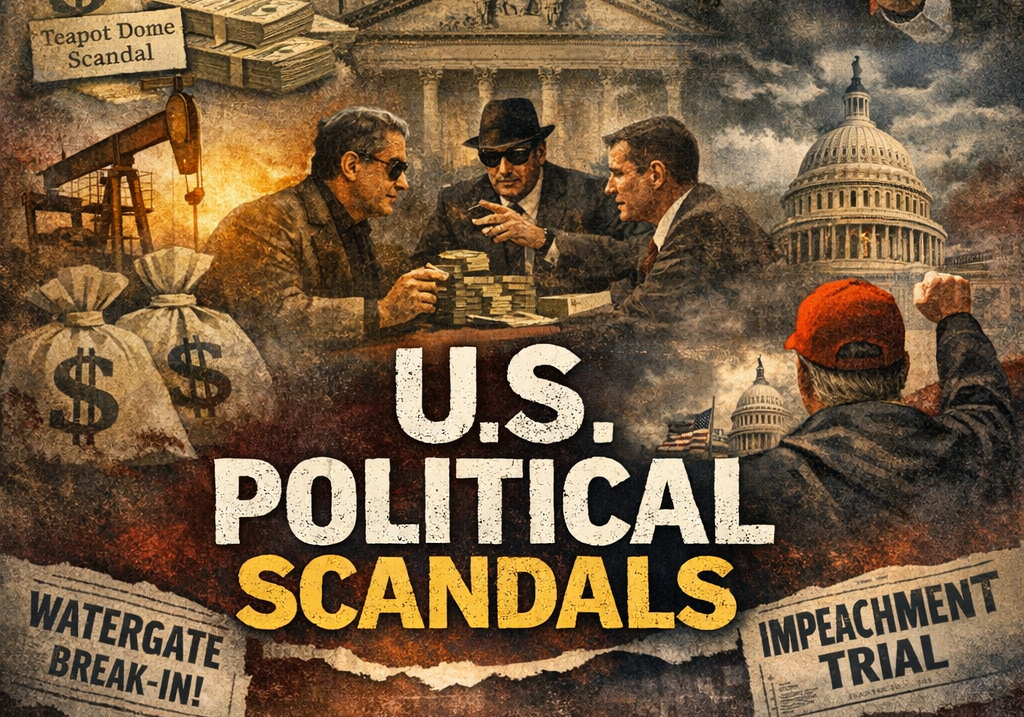
This guide focuses on scandals that (1) had major national consequences, (2) stress-tested core institutions (Congress, courts, executive branch oversight), and (3) produced lasting reforms or precedent-setting outcomes. The summaries below aim to be nonpartisan and evidence-based, emphasizing documented findings, official investigations, and widely recognized historical accounts.
Table of Contents
- Scoring Rubric: Ranking Scale and Institutional Damage
- Crédit Mobilier (1872–1873)
- Whiskey Ring (1871–1875)
- Teapot Dome (1921–1929)
- Watergate (1972–1974)
- ABSCAM (1978–1981)
- Iran-Contra (1985–1987)
- Keating Five (late 1980s–1991)
- Clinton–Lewinsky & Impeachment (1998–1999)
- Abramoff Lobbying Scandal (2000s)
- Warrantless Wiretapping / Terrorist Surveillance Program (revealed 2005)
- Operation Fast and Furious (2009–2012)
- Other Oversight Turning Points (Pentagon Papers, Church Committee)
- FAQ (Search-optimized, schema-friendly)
- Further Reading (Primary and high-quality sources)
Scoring Rubric: Ranking Scale and Institutional Damage
How to score a scandal (1–5 per category)
Use this rubric to compare scandals consistently. Score each category from 1 (low) to 5 (very high), then total the points.
| Category | What to look for | Quick scoring guide |
|---|---|---|
| Constitutional stakes | Impeachment risk, separation-of-powers conflict, major Supreme Court implications | 1 = minimal, 3 = serious oversight clash, 5 = constitutional crisis |
| Scale of corruption or abuse | Money involved, scope of misconduct, number of actors/agencies implicated | 1 = isolated, 3 = multi-actor, 5 = systemic |
| Evidence strength | Tapes, documents, sworn testimony, convictions, inspector general findings | 1 = mostly allegations, 3 = substantial findings, 5 = overwhelming proof |
| Institutional fallout | Resignations, prosecutions, impeachment, agency shakeups | 1 = minor, 3 = significant, 5 = historic-scale |
| Reform tail | New laws, oversight bodies, ethics rules, enforcement changes | 1 = little change, 3 = notable reforms, 5 = major overhaul |
Interpretation tip: A scandal can score high on “institutional damage” even if the dollar amount is small, if it weakens norms, oversight, or public trust at scale.
1) Crédit Mobilier (1872–1873): Railroad profiteering and congressional influence
What happened: Crédit Mobilier of America was tied to the Union Pacific Railroad’s construction and became infamous as a vehicle for insiders to profit from railroad building and financing. When the scandal broke publicly, it included allegations that shares and benefits were distributed to influential figures to soften oversight and protect favorable outcomes.
What changed after this?
- Oversight expectations increased for large-scale infrastructure and finance deals (even when reforms were gradual rather than immediate).
- Reform momentum: strengthened public demand for anti-corruption measures and professionalization of government administration in the decades that followed.
- Long-term lesson: “contracting + financing” layers often become the vulnerability when oversight is weak.
Key sources:U.S. House historical overview, PBS American Experience background
2) Whiskey Ring (1871–1875): Tax fraud and corruption inside federal revenue collection
What happened: A network involving distillers and corrupt officials worked to evade federal excise taxes on whiskey, keeping production underreported and splitting gains. The scandal became a major political issue during the Grant administration, highlighting how corruption can embed itself in routine administration.
What changed after this?
- Enforcement and controls: reinforced the case for tighter internal controls and inspections in federal revenue systems.
- Accountability tools: helped normalize the idea of using special investigative mechanisms for high-level misconduct when ordinary enforcement is compromised.
- Governance lesson: corruption risks often live inside “boring” processes like tax collection and audits.
Key sources:National Archives (Prologue) deep dive, History.com explainer
3) Teapot Dome (1921–1929): Bribery tied to federal oil reserves
What happened: Federal oil reserves intended for the Navy were leased to private interests under terms that drew intense scrutiny. The scandal led to major investigations, civil litigation, and criminal cases. Interior Secretary Albert B. Fall was convicted in a bribery-related case, historically notable as the first cabinet official convicted of a felony.
What changed after this?
- Public resource governance: strengthened expectations for transparency and accountability in leasing and managing public assets.
- Congressional investigations: reinforced the legitimacy and power of congressional oversight in high-corruption cases.
- Deterrence precedent: made clear that cabinet-level officials can face criminal consequences for bribery and corruption.
Key sources:U.S. Senate historical feature, Federal Judicial Center teaching handout (PDF)
4) Watergate (1972–1974): The modern benchmark for presidential scandal
What happened: A break-in at the Democratic National Committee headquarters, followed by investigations and revelations, expanded into a broader crisis involving abuse of power and obstruction-related conduct. The scandal culminated with President Richard Nixon resigning on August 9, 1974 under threat of impeachment.
What changed after this?
- Campaign finance enforcement: the Federal Election Commission (FEC) was established in 1975 to administer and enforce federal campaign finance law.
Source - Ethics and oversight infrastructure: Congress passed the Ethics in Government Act (1978) and the Inspector General Act (1978) as part of the post-Watergate reform era.
Source - Transparency: Congress overrode President Ford’s veto and enacted the FOIA amendments (1974), strengthening public access to government records.
Source
Key sources:National Archives exhibit: Nixon & Watergate, National Archives lesson: Watergate and the Constitution
Why Watergate endures: Scandals often expand because institutions react defensively, hide facts, or obstruct oversight. The “cover-up” becomes the governance crisis.
5) ABSCAM (1978–1981): An FBI sting that led to congressional convictions
What happened: ABSCAM was a high-profile FBI undercover operation that used a fictitious business setup and recorded interactions with public officials. The case led to convictions for bribery and corruption, including one U.S. senator and six members of the U.S. House.
What changed after this?
- Ethics enforcement attention: increased pressure on Congress to tighten ethics guidance and strengthen enforcement norms.
- Corruption investigations: reinforced undercover tactics as a tool for public corruption cases, alongside ongoing debates about boundaries and entrapment.
- Public trust lesson: recorded evidence can rapidly shift the public’s perception of “how Washington works.”
Key sources:FBI case history, Encyclopedia of Greater Philadelphia overview
6) Iran-Contra (1985–1987): Covert policy, funding diversion, and oversight breakdown
What happened: The Iran-Contra affair involved covert activities connecting U.S. foreign policy objectives, arms sales, and support for the Nicaraguan Contras, drawing intense scrutiny from Congress and multiple investigations. A major congressional report was issued in 1987.
What changed after this?
- Stronger oversight norms: sharpened expectations that covert operations require clear authorization, documentation, and credible congressional oversight.
- National security governance: increased scrutiny of NSC processes, chains of command, and “plausible deniability” structures.
- Institutional lesson: secrecy + complexity increases risk, even without traditional “cash corruption.”
Key sources:Excerpts: Congressional committees’ Iran-Contra report (1987), Levin Center: oversight “portrait” of Iran-Contra
7) Keating Five (late 1980s–1991): Money, regulators, and the “appearance” problem
What happened: Five senators faced scrutiny for contacts with regulators on behalf of savings-and-loan executive Charles Keating. Senate ethics proceedings concluded with a range of outcomes, including criticism and a reprimand for one senator, while others were criticized for poor judgment or cleared of impropriety.
What changed after this?
- Ethics optics became a core standard: increased attention to how fundraising, access, and official actions can appear linked even when framed as constituent service.
- Disclosure expectations: reinforced public demand for transparency around relationships between donors and official intervention with regulators.
- Long-term lesson: “Not illegal” does not always mean “trust-preserving.”
Key sources:CQ Almanac: contemporaneous reporting and context, Overview summary page
8) Clinton–Lewinsky and impeachment (1998–1999): Personal misconduct becomes constitutional conflict
What happened: Investigations led the House to impeach President Bill Clinton on December 19, 1998. The Senate trial began in January 1999 and ended with acquittal on February 12, 1999.
What changed after this?
- Independent counsel system ended: the statutory “independent counsel” provisions expired on June 30, 1999 and were not renewed, shifting future high-profile investigations to DOJ special counsel regulations and other mechanisms.
DOJ historical summary - Impeachment norms shifted: impeachment became more normalized as a high-stakes political process, not only a rare constitutional remedy.
- Media and polarization effects: accelerated the modern “scandal ecosystem,” influencing how later controversies are investigated and communicated.
Key sources:Library of Congress: Federal Impeachment guide (Clinton), History.com: acquittal date and overview
9) Abramoff lobbying scandal (2000s): Influence peddling and lobbying reform pressure
What happened: Lobbyist Jack Abramoff’s misconduct became a major public corruption story, leading to extensive investigations, convictions, and high-profile fallout. The case is frequently cited as a modern example of how gifts, travel, intermediaries, and access-driven tactics can distort policymaking.
What changed after this?
- Lobbying and ethics reforms: Congress passed the Honest Leadership and Open Government Act of 2007 (Public Law 110-81), tightening lobbying rules and related ethics requirements.
Congress.gov bill page - Visibility into influence networks: accelerated scrutiny of gifts, sponsored travel, and the role of intermediaries in policy outcomes.
- Enforcement lesson: corruption can be “legal-adjacent” until documented patterns show quid pro quo behavior or deception.
Key sources:U.S. DOJ press release (sentencing), Levin Center: oversight “portrait” on Abramoff scandal
10) Warrantless wiretapping / Terrorist Surveillance Program (revealed 2005): surveillance, secrecy, and legal authorities
What happened: Reporting and investigations revealed that the U.S. government conducted certain warrantless surveillance activities after 9/11, triggering intense debate about legality, oversight, privacy, and separation of powers.
What changed after this?
- New legal authorities and guardrails: Congress enacted major FISA-related updates in 2007 and 2008, including the FISA Amendments Act of 2008 (notably Section 702), reshaping how foreign intelligence surveillance is authorized and overseen.
DNI explainer (PDF) - Expanded oversight debate: intensified ongoing tension between national security arguments and civil liberties concerns around surveillance scope and “incidental” collection.
- Institutional lesson: fast-moving crises can produce long-lived authorities that remain controversial and require periodic review.
Key sources:Congressional Research Service: FISA background (overview), DNI: Section 702 basics (PDF)
11) Operation Fast and Furious (2009–2012): ATF tactics, oversight, and internal controls
What happened: Operation Fast and Furious became a major controversy after flawed firearms trafficking investigative tactics were scrutinized by Congress and watchdogs. Multiple reports and hearings examined failures of supervision and decision-making.
What changed after this?
- Operational policy shifts: reforms and internal changes were implemented to reduce or prevent similar tactics, including stronger prohibitions on allowing illegal firearms transfers without interdiction.
- Leadership and accountability: resignations and agency changes followed, and oversight bodies issued recommendations for improved controls.
- Oversight precedent: reinforced congressional investigative leverage around DOJ and law enforcement operational transparency.
Key sources:House Oversight: hearing page and materials, Levin Center: Fast and Furious oversight “portrait”
Other oversight turning points that reshaped trust and accountability
Pentagon Papers (1971): Leaks, press freedom, and the limits of prior restraint
What happened: Portions of a major classified study about U.S. involvement in Vietnam were leaked and published. The resulting legal conflict tested whether the government could stop publication in advance. The Supreme Court’s decision remains a landmark in U.S. press freedom jurisprudence.
What changed after this?
- Press freedom precedent: reinforced a high bar for prior restraint, shaping future publication fights involving classified materials.
- Transparency norms: strengthened long-term expectations that public interest can outweigh secrecy claims in certain contexts.
Key sources:National Archives: Pentagon Papers overview, Oyez: New York Times Co. v. United States
Church Committee (1975–1976): Investigating intelligence abuses
What happened: A Senate select committee investigated intelligence abuses by federal agencies, documenting improper or unlawful activities and catalyzing reforms in oversight practices.
What changed after this?
- Permanent intelligence oversight: the Senate approved Resolution 400 (1976), creating the Senate Select Committee on Intelligence for ongoing oversight.
Senate citations (PDF) - Surveillance law framework: the committee’s findings helped lead to enactment of the Foreign Intelligence Surveillance Act (FISA) (1978).
Congress (Constitution Annotated) overview
Key sources: U.S. Senate: Church Committee overview, Constitution Annotated: Watergate, Church, and Pike investigations
FAQ
What is the biggest political scandal in U.S. history?
Many historians treat Watergate as the modern benchmark because it escalated into a constitutional crisis and produced lasting reforms across campaign finance, transparency, and oversight. However, “biggest” depends on whether you prioritize corruption scale, institutional damage, or reform impact.
What’s the difference between a scandal and a controversy?
A scandal typically involves documented misconduct (investigations, findings, convictions, resignations), while a controversy may involve disputed claims, partisan conflict, or policy disagreement without a clear factual record of wrongdoing.
Why do political scandals repeat across history?
Most recur due to the same risk factors: secrecy, weak controls, conflicts of interest, and incentives to protect power. When oversight is delayed or resisted, the “cover-up” dynamic often becomes the real institutional crisis.
How can I rank scandals objectively?
Use a scoring framework like the rubric above: constitutional stakes, scale, evidence strength, institutional fallout, and reform tail. Total scores help compare cases across different eras.
Where should I start if I want primary sources?
Start with government sources: National Archives, Congress.gov, Congressional Research Service, Senate historical pages, and official inspector general reports.
Further Reading (Primary and high-quality sources)
- Crédit Mobilier:U.S. House historical overview, PBS American Experience
- Whiskey Ring:National Archives (Prologue)
- Teapot Dome:U.S. Senate feature, Federal Judicial Center (PDF)
- Watergate + reforms:National Archives exhibit, FEC historical timeline, U.S. House: FOIA history
- ABSCAM:FBI case history
- Iran-Contra:Congressional report excerpts
- Keating Five:CQ Almanac
- Clinton impeachment + independent counsel expiration:Library of Congress guide, DOJ: independent counsel history
- Abramoff + lobbying reform:Congress.gov: HLOGA (2007), Levin Center overview
- Warrantless wiretapping / FISA updates:CRS: FISA background, DNI: Section 702 basics (PDF)
- Fast and Furious:House Oversight materials, Levin Center overview
- Pentagon Papers / press freedom:National Archives overview, Oyez case summary
- Church Committee / intelligence oversight:U.S. Senate overview, Constitution Annotated overview