
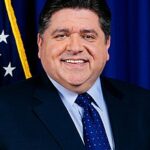
 Governor J.B. Pritzker is a Democrat serving as the 43rd Governor of Illinois. He was first sworn in on January 14, 2019, and began a second term in January 2023 after winning re-election. As governor, he leads the executive branch of state government, proposes budgets, signs or vetoes legislation passed by the Illinois General Assembly, and directs statewide agencies responsible for areas such as transportation, public health, education funding administration, and economic development.
Policy Effectiveness and Legislative Record
Pritzker’s governing record has been defined by a high volume of enacted policy, much of it advanced in partnership with Democratic legislative majorities, alongside targeted bipartisan deals in areas such as capital construction. Early in his first term, Illinois enacted a phased increase to a $15 statewide minimum wage by 2025, and the state legalized adult-use cannabis with a framework that included expungement and social equity components. His administration also pursued major infrastructure investment through the “Rebuild Illinois” capital program, which set multi-year funding for transportation and public facilities.
On fiscal policy, Pritzker has emphasized multi-year budgeting practices, bill-payment timeliness, and reserve building. Illinois’ credit profile has been cited by multiple observers as improving during his tenure, including credit rating upgrades from major agencies in the post-2021 period, though Illinois has continued to face long-term structural pressures, particularly from pension liabilities.
In climate and energy policy, Pritzker signed the Climate and Equitable Jobs Act (CEJA) in 2021, which established a long-run transition framework for clean energy and workforce programming. In criminal justice and policing, he signed the SAFE-T Act in 2021, a broad package that included reforms to policing practices and pretrial procedures, including the elimination of cash bail through the Pretrial Fairness provisions (implemented later through scheduled effective dates and subsequent amendments).
Key Votes and Voting Record
Governors do not cast roll-call votes like legislators, but their “record” is reflected in the major bills they sign, veto, or negotiate. Pritzker’s most high-impact approvals include several measures that function as clear indicators of his policy priorities:
- Minimum wage expansion (2019): Signed legislation to raise Illinois’ minimum wage in scheduled steps to $15/hour by 2025, shaping statewide labor costs and wage floors.
- Adult-use cannabis legalization (2019): Approved a regulatory and taxation system for recreational cannabis, coupled with expungement and equity provisions, positioning Illinois among the earlier Midwestern adopters of legalization.
- Rebuild Illinois capital plan (2019): Signed a long-term capital program funding roads, bridges, transit, and public infrastructure projects, frequently described as a bipartisan achievement due to cross-party legislative support.
- Reproductive health policy (2019 and 2023): Signed the Reproductive Health Act in 2019 and later approved additional protections in 2023 aimed at shielding providers and patients from certain out-of-state legal actions after changes in federal abortion precedent.
- SAFE-T Act (2021): Signed a major criminal justice reform package affecting policing standards and pretrial practices, which drew strong support from reform advocates and significant opposition from some law enforcement and Republican officials.
- Climate and energy transition (2021): Signed CEJA, establishing statewide clean-energy and workforce pathways with targets extending into the 2040s.
- Firearms regulation (2023): Signed the Protect Illinois Communities Act, restricting certain firearms and high-capacity magazines; the law has been the subject of ongoing litigation and conflicting court rulings at different stages.
Across these examples, a recurring pattern is that the most contested bills tended to pass largely along party lines, while major capital and certain budget items more often included at least some bipartisan bargaining. “Cross-party” outcomes have generally been more visible in infrastructure and localized economic initiatives than in high-salience social policy.
Ethics and Controversies
Pritzker’s most widely reported ethics-related controversy predates his governorship but continued to draw scrutiny after he took office: a property-tax assessment dispute involving a Gold Coast mansion in Chicago, where the removal of toilets was cited in reporting about an effort to have the property classified as uninhabitable for tax purposes. Pritzker publicly stated he would repay the tax benefit associated with the assessment reduction.
During the COVID-19 pandemic, Pritzker’s emergency orders and business restrictions were also a source of sustained controversy and litigation risk, as occurred nationally for many governors. Supporters argued these measures helped manage hospital capacity and public health outcomes, while opponents criticized the economic impact and executive-branch reach.
Constituent Service and Public Engagement
As governor, Pritzker’s public engagement has been centered on statewide communications, agency implementation, and high-frequency press briefings during emergencies. His administration has used public bill signings, budget addresses, and agency-led announcements to communicate policy rollouts, and he has maintained an active public presence through official events, regional visits, and digital channels. Constituent “casework” in the traditional congressional sense is less central to a governor’s role, but responsiveness is often judged through crisis management (such as pandemic response), disaster proclamations, and the speed and clarity of agency guidance affecting residents and businesses.
Bipartisanship and Collaboration
Illinois’ partisan landscape during Pritzker’s tenure has generally featured Democratic control of the governorship and the legislature, which has enabled faster alignment on major policy packages. Even so, some of the most durable collaboration has appeared in infrastructure planning and certain regionally focused initiatives that require cooperation among state agencies, municipalities, and business stakeholders. The 2019 capital plan is frequently cited as an example of cross-party legislative collaboration tied to broad geographic distribution of projects.
At the same time, several signature initiatives, including criminal justice reforms and firearms restrictions, have been sharply polarized, with strong Republican opposition and varying levels of support from local officials across the state.
Recent Focus and Public Stances
In recent sessions, Pritzker has continued to prioritize budgets, economic development, infrastructure, and high-profile social policy. Late 2025 actions included signing legislation aimed at stabilizing and restructuring public transit funding in the Chicago region, reflecting ongoing attention to transportation governance and long-term operating revenue. He also signed a medical aid-in-dying law in December 2025, scheduled to take effect in 2026, placing Illinois among a limited number of states with such a framework.
His public messaging has generally emphasized fiscal stability, infrastructure modernization, workforce development, and positioning Illinois as a regional policy leader on issues such as reproductive healthcare access and clean energy transition planning.
Conclusion
Governor J.B. Pritzker’s time in office has been marked by substantial legislative throughput and a focus on large-scale, state-level policy shifts, including wage policy, cannabis legalization, infrastructure investment, clean energy transition planning, and major reforms to criminal justice and firearms regulation. His record reflects both the advantages of unified party control for passing broad agendas and the intensified controversy that accompanies high-salience issues. Evaluations of his performance typically center on fiscal management trends, implementation capacity across state agencies, and the legal and political durability of major reforms enacted during his tenure.